
Tips for New Home Care Caregivers in Madison, WI

Entering someone’s home as a caregiver means becoming part of an established environment filled with personal memories, familiar routines, and individual preferences. A favorite chair, morning activity, or preferred way of preparing meals may hold special meaning for the older adult receiving assistance.
For new caregivers, building trust begins with listening, observing, and understanding how the senior prefers to receive support. Families exploring home care services in Madison, WI may also want to understand how caregivers establish respectful relationships while helping with everyday responsibilities.
At Always Best Care of Madison, we recognize that dependable nonmedical home care involves more than completing assigned tasks. Clear communication, respect for personal choices, and an understanding of professional responsibilities can help create a more comfortable caregiving experience.
The following practical tips can help new home care caregivers approach their responsibilities with confidence while maintaining the senior’s independence and dignity.
Table of Contents
Why Is Preparation Important for New Home Care Caregivers?
A successful caregiving relationship begins with understanding the individual’s needs, preferences, and established care arrangements.
New caregivers should familiarize themselves with the authorized care plan and ask questions before providing assistance.
Preparation can help prevent misunderstandings and ensure that responsibilities remain consistent with the agency’s procedures
Understand the Senior’s Individual Care Plan
Every senior has different daily routines, abilities, and personal preferences.
Before beginning assigned activities, caregivers should review the current care plan through the agency’s approved process.
Important information may include:
- Assigned personal care and household responsibilities.
- Preferred daily routines and communication styles.
- Relevant safety instructions and household arrangements.
- Documentation and reporting requirements.
- Emergency contacts and escalation procedures.
Understanding these details can help caregivers provide appropriate assistance without making unnecessary assumptions.
When instructions appear incomplete or contradictory, caregivers should contact their supervisor rather than independently changing the care arrangement.
Ask How the Senior Prefers to Receive Assistance
A new caregiver should begin by introducing themselves respectfully and asking how the senior would like to approach the day’s activities.
Some older adults appreciate detailed explanations before receiving assistance. Others prefer brief conversations and familiar routines.
For example, a senior may welcome help preparing breakfast but still want to choose the ingredients or arrange the table independently.
Respecting these preferences can make assistance feel more collaborative.
Caregivers should avoid taking over activities simply because completing them independently might be faster.
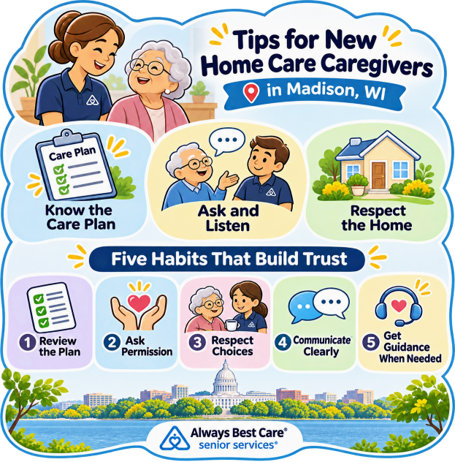
Five Habits That Help New Caregivers Build Trust
Trust often develops through consistent behavior rather than a single conversation.
Caregivers can create a positive first impression by being prepared, respecting boundaries, and following through on agreed responsibilities.
A Strong Foundation for Daily Assistance
The following five habits can help new caregivers establish a respectful and organized approach to everyday support.
- Review the care plan. Understand assigned responsibilities and clarify unfamiliar instructions before beginning assistance.
- Ask permission. Explain what you intend to do before touching personal belongings or providing hands-on support.
- Respect personal choices. Allow the senior to participate in decisions about familiar routines whenever appropriate.
- Communicate clearly. Share factual observations through the agency’s approved reporting procedures.
- Request guidance when needed. Contact a supervisor when instructions are unclear or a situation falls outside the caregiver’s responsibilities.
These habits remain important beyond the first visit.
As the caregiving relationship develops, preferences and circumstances may change. Continuing to ask questions and confirm expectations helps ensure that assistance remains appropriate.
Respect the Household’s Existing Arrangement
A senior’s home should not be reorganized simply to match a caregiver’s personal preferences.
For example, someone may keep frequently used kitchen items in particular locations because the arrangement feels familiar.
Before moving belongings, reorganizing supplies, or changing household routines, caregivers should ask permission and follow the appropriate care process.
Respecting the home environment can help preserve the senior’s comfort and independence.
How Can New Caregivers Build Meaningful Relationships with Seniors?
Caregiving relationships often develop through everyday interactions.
Listening to personal stories, remembering preferred activities, and respecting communication styles can help seniors feel acknowledged.
Understanding why great caregivers matter in home care can also help families recognize the value of dependable assistance and thoughtful communication.
Practice Respectful and Patient Communication
Caregivers should speak directly to the senior using a respectful, adult tone.
Avoid speaking only to family members when the older adult can participate in the conversation.
When communication takes longer, allow sufficient time for responses rather than interrupting or finishing sentences.
A caregiver may also ask whether the senior prefers a particular name or form of address.
Small considerations like these can make daily interactions more comfortable.
Learn About Personal Interests and Familiar Activities
Conversations about favorite music, hobbies, family traditions, or everyday interests can help caregivers better understand the person receiving assistance.
For example, a senior who enjoys gardening may appreciate companionship while caring for indoor plants.
Another person may prefer reading, listening to music, or discussing family photographs.
Caregivers should encourage appropriate activities based on the senior’s interests and the agreed-upon care plan.
Building familiarity should happen naturally without pressuring the senior to share personal information.

What Should New Caregivers Document and Report?
Accurate communication helps families, supervisors, and authorized caregivers understand what occurred during a visit.
Documentation should focus on observable facts rather than assumptions about medical conditions, emotions, or motivations.
Record Clear and Factual Observations
Caregivers should follow the agency’s approved documentation procedures.
For example, a note stating that a senior declined a planned outing provides more useful information than describing the person as difficult or uncooperative.
Similarly, documenting that a meal was left unfinished is more appropriate than assuming why the senior did not eat.
Useful records may include completed activities, relevant preferences, observations requiring follow-up, and actions taken according to the reporting process.
Caregivers should also identify whom they notified when required.
Use a Simple Caregiver Handover
When multiple caregivers assist the same senior, a clear handover helps maintain consistent support and prevents important information from being overlooked. Caregivers should communicate which personal care or household tasks were completed, any agreed-upon changes to daily routines, and relevant preferences the senior wants respected during future visits.
Handover updates should also include factual observations, concerns already reported to the appropriate person, and outstanding tasks requiring follow-up or supervisory guidance. Sharing this information helps authorized caregivers understand their responsibilities and continue providing personalized assistance without unnecessary confusion.
All handover information should remain brief, accurate, and confidential. Caregivers must follow the agency’s approved communication procedures to protect the senior’s privacy and maintain continuity of care.
Protect Personal Information and Household Privacy
Caregivers may encounter private information while assisting with everyday activities.
This information should not be discussed with friends, shared through personal social media accounts, or disclosed to unauthorized individuals.
Photographs taken inside a client’s home may also reveal personal details even when the senior is not visible.
Caregivers should follow agency policies regarding confidentiality, documentation, photography, and information sharing.
Respecting privacy is an essential part of maintaining professional trust.
How Should Caregivers Respond When They Need Additional Guidance?
New caregivers should understand that asking questions is part of providing responsible assistance.
Not every situation can be resolved through an individual decision, particularly when a request involves medical concerns, safety procedures, or changes to authorized responsibilities.
Know When to Contact a Supervisor
Caregivers should understand whom to contact for routine questions and which procedures apply outside normal office hours.
For example, a family member may request an additional task that is not included in the current care plan.
Rather than making a private agreement, the caregiver should explain that the request needs to be reviewed through the agency’s established process.
Clear escalation procedures help ensure that everyone understands which responsibilities are authorized.
Follow Emergency Procedures When Necessary
Caregivers should know where approved emergency instructions are kept and how to obtain appropriate assistance.
Emergency situations require prompt action according to the agency’s procedures and the individual’s response plan.
A routine handover message should not replace emergency assistance when immediate intervention is necessary.
Caregivers should receive appropriate instruction on these procedures before being expected to follow them.
How Can Caregivers Support Seniors with Diabetes Within Their Role?
Some older adults receiving home care may also be managing diabetes or other chronic medical conditions.
Nonmedical caregivers can assist with appropriate everyday activities while following the established care plan and respecting clinical boundaries.
Support Daily Routines Without Making Medical Decisions
Understanding diabetes support within everyday home routines can help caregivers recognize how practical assistance may complement a clinician-directed treatment plan.
Depending on the authorized arrangement, caregivers may assist with meal preparation, companionship, household activities, or other agreed-upon responsibilities.
However, nonmedical caregivers should not independently diagnose diabetes, change medication doses, establish blood glucose targets, or recommend medical treatments.
When a senior raises a medical question outside the caregiver’s role, the concern should be directed to the appropriate healthcare professional.
Respond to Health Concerns Through Established Procedures
Caregivers should understand which observations require prompt reporting and how to follow the individual’s emergency instructions.
For example, sudden changes in responsiveness or other severe symptoms may require immediate emergency assistance.
An unconscious person should never be given food or drink because they may be unable to swallow safely.
Caregivers should follow authorized instructions, appropriate training, and agency procedures rather than improvising a medical response.
What Questions Should New Caregivers Ask Before Starting?
Clear expectations can help new caregivers feel more prepared and reduce confusion during early visits.
Before beginning an assignment, caregivers should confirm their responsibilities and understand how questions or concerns should be handled.
Questions That Clarify a Care Arrangement
The following table highlights practical questions caregivers can discuss with their supervisor or authorized care team.
| Area to Clarify | Questions to Ask |
|---|---|
| Assigned Responsibilities | Which activities are included in the current care plan? |
| Personal Preferences | How does the senior prefer assistance to be offered? |
| Communication | Who should receive routine updates or questions? |
| Urgent Concerns | What reporting and emergency procedures should be followed? |
| Caregiver Consistency | How are preferences and relevant updates shared between authorized caregivers? |
These questions can help caregivers understand expectations while supporting consistent, respectful assistance.
Confirm Expectations Before Making Changes
Care arrangements should not be changed through informal agreements that bypass the responsible supervisor or agency.
When a family requests additional assistance, a schedule adjustment, or another change, caregivers should listen respectfully and follow the established approval process.
This approach helps protect the senior, family, and caregiver by keeping responsibilities clear.
Why Are Professional Boundaries Important in Home Care?
Professional boundaries help caregivers provide warm, personalized assistance while maintaining appropriate responsibilities.
Being friendly does not require sharing private information, accepting unauthorized tasks, or becoming involved in decisions outside the caregiver’s role.
Balance Compassion with Professional Responsibilities
Caregivers can demonstrate compassion through patience, respectful conversation, and attention to personal preferences.
At the same time, they should follow agency procedures, protect confidentiality, and communicate concerns through authorized channels.
If a request falls outside the agreed-upon arrangement, the caregiver should explain the need for supervisory guidance rather than making an uncertain promise.
Develop Sustainable Work Habits
New caregivers benefit from consistent supervision, clear scheduling expectations, and opportunities to ask questions.
After a visit, caregivers may identify an instruction that needs clarification or a communication process that could be improved.
These concerns should be discussed through the appropriate professional channels without disclosing private client information elsewhere.
Individuals interested in caregiving as a profession can also explore caregiver roles and employment opportunities to learn more about available recruitment information.
Building dependable work habits can help caregivers approach their responsibilities with greater confidence.
Building Confidence Through Respectful Home Care in Madison, WI
A positive caregiving relationship begins with listening, preparation, and a clear understanding of responsibilities.
New caregivers can support seniors by following authorized care plans, respecting personal preferences, documenting factual observations, and communicating appropriately with families and supervisors.
These practices help create a caregiving environment where older adults remain involved in everyday decisions while receiving practical assistance.
At Always Best Care of Madison, we recognize the importance of respectful communication and personalized nonmedical support.
Families considering home care services in Madison, WI, can discuss how available services may fit their loved one’s daily routine and individual preferences.
Call (608) 315-2378 or connect with our care team about personalized assistance to learn more about appropriate home care support for your family.